

Europe’s fruit industry is entering a period in which climate risk will not be felt evenly. Some regions may face greater frost exposure during the growing season, while others are likely to see more hail, heavier rainfall or pressure on water supplies. For growers, insurers and buyers, the question is no longer whether climate change will affect production, but where the risks are likely to concentrate and how quickly the sector can adapt.
The figures are concerning. The European State of the Climate 2025 report highlights that Europe is the fastest-warming continent and has warmed more than twice as fast as the global average. Globally, recent years have also been the warmest on record, with temperatures approaching the 1.5 °C threshold set out in the Paris Agreement. Accompanying the rise in temperatures is an increase in extremes such as heat waves, droughts and downpours. How these trends will affect fresh fruit production in Europe is a key question.
A recent report by the European Investment Bank (EIB) and European Commission (EC) identifies the main climate risks for fruit crops in Europe in terms of insurance claims and compensation: frost, hail, and extreme rainfall.
Drought also affects fruit crops, especially during flowering and fruit set, when water stress can reduce fruit size and cause immature fruit to drop. Although many fruit crops are irrigated, drought cannot be dismissed. In water-stressed regions, irrigation itself may become harder or more expensive to maintain, and drought intensity may redraw the map of European agriculture. Southern Europe is projected to receive less rainfall, putting strain on local water supplies.
Similar to drought, the trends for the other climate risks won’t play out in the same way in all regions. The EIB/EC report provides future risk maps for each, assuming greenhouse gas emissions peak around 2040 and then decline. At the same time, the uneven distribution of fruit crops across Europe means that not all areas are equally exposed. The European Commission has statistics on the production value of fruit by region in 2023, the year for which we have the most complete data. Comparing these risk maps with the distribution of fruit production value can give an indication of how climate change may affect the fresh fruit industry in Europe.
Uneven Exposure
Frost is particularly dangerous for fruit crops because it often occurs in the spring when soft plant tissues are just emerging. A late spring frost can spell disaster for fruit farmers, who may lose much of their crop overnight. Increased frost risk in some areas may seem counterintuitive given that the climate is warming. The explanation is that the biological spring is arriving earlier, moving up the date of flowering and fruit set and increasing vulnerability to frost in late February, March, and April. Although the annual number of frost days may be decreasing with warming, the number of frost days included in the growing season may be increasing.
Climate models suggest that frost risk during the growing season will increase most in France, Belgium, the Netherlands, and central Spain, where up to four more frost days are expected in 2050 than in 1990. In France, increased frost risk overlaps with high fruit production value regions, including Centre-Val de Loire (€184M), Limousin (€78M), and Rhône-Alpes (€409M).
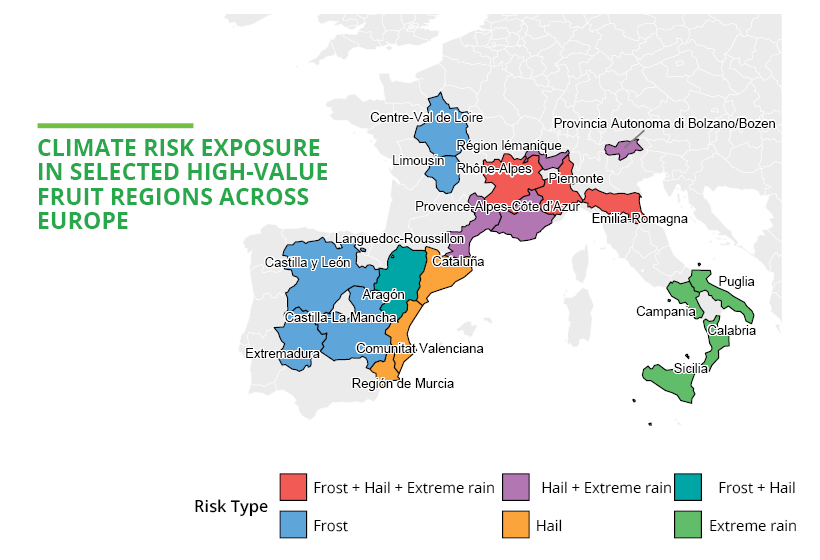
There is a lot of fruit production both in the Netherlands and Belgium, but much of it is in greenhouses, and therefore protected from frost. Greater frost risk in central Spain will affect Aragón (€787M), Castilla-La Mancha (€791M), Extremadura (€683M), and Castilla y León (€237M). In northern Italy, Emilia-Romagna (€416M) and Piemonte (€266M) are also at greater risk of frost. In contrast, frost risk will decrease in Poland, southern Italy, coastal Spain, and western France, where there is also significant fruit production.
While hail and extreme rainfall events may be localized and short-lived, they can cause catastrophic damage to fruit crops. Hail and, to some extent, rain can damage or knock off flowers and maturing fruit from trees and vines. Larger hailstones can rip through leaves and bruise or splinter stems, branches, and trunks. In addition to directly damaging fruit and trees, heavy rainfall and humidity can lead to conditions favorable for the proliferation of pests and disease. Waterlogged soils can further inhibit root growth. As with frost, fruit crops are more vulnerable to hail and extreme rainfall when their reproductive organs are forming during flowering and fruiting.
Climate models show that the risk of hail and extreme rainfall will increase in similar areas across Europe. By 2050, the frequency of heavy hail with stone size above 10 mm is expected to increase by 15-20% relative to that of 1990 across large areas of the Mediterranean and around the Alps. Extreme rainfall events, measured by maximum cumulative five-day precipitation, will increase by more than 20 mm over the same period in many of the same regions, notably in Italy and southern France.
The following high fresh fruit production value regions are at greater risk of both heavy hail and rain: Provence-Alpes-Côte d’Azur (€1.09B), Rhône-Alpes (€409M), and Languedoc-Roussillon (€493M) in France; Piemonte (€266M), Emilia-Romagna (€416M), and Provincia Autonoma di Bolzano/Bozen (€437M) in Italy; and Région lémanique (€285M) in Switzerland. Additionally, there will be more hail in eastern Spain in Cataluña (€756M), Aragón (€787M), Comunitat Valenciana (€1.7B), and Región de Murcia (€837M). Extreme rainfall will also increase in southern Italy in Campania (€523M), Calabria (€562M), Puglia (€627M), and Sicily (€1.85B).
For the industry, these risks are not only a production issue. More volatile weather can affect the timing, size and quality of crops, making supply programs harder to plan and increasing the need for alternative sourcing options when key regions come under pressure.
A simple comparison of future climate risks and current regions of high fruit production value leaves out a key factor: the potential for adaptation. The EIB/EC report mapping climate risks also lists adaptation measures such as supportive policies under the EU Green Deal, crop diversification, technological advances, and regenerative agriculture. Among these options, tools for capturing field data and analyzing the effects of climate on fruit crops may offer one readily available short-term response.
In a warming Europe, fruit growers cannot rely on past experience alone to understand how the climate will influence their crops in the future. Extreme events may become more frequent and intense, and their effects will not stop at the farm gate. Tracking how crops respond to these pressures can help growers prepare for the next shock, while giving buyers, importers and insurers a clearer sense of where supply risk is rising.
- Adam Formica is the head of research at Sensonomic, an Oslo, Norway-based software services and agricultural risk analytics provider.